The Factory Floor Is Running 2025 Operations on 2005 Software. Factory Apps Wants to Fix That.
How a Solo Founder With Two Engineering Degrees Is Building Web Tools for the Manufacturing Companies the SaaS World Forgot
Factory Apps is a platform building modern web tools for production and manufacturing companies still running daily operations on Excel and Word. Founded by an engineer with a background in logistics, lean management, and economics, the practice is targeting Europe's Industry 4.0 wave with flat-rate, team-friendly software designed around how factories actually work.
Walk into most small and mid-sized manufacturing plants today and you'll find something strange. Robots on the line. Sensors on the equipment. Sophisticated supply chains feeding the floor. And then, holding it all together, a Frankenstein stack of emailed spreadsheets, paper logs, and tribal knowledge living inside one senior technician's head.
That contradiction is the entire reason Factory Apps exists.
The Build, in Plain Terms
Factory Apps is a platform that designs and ships web-based tools for production and manufacturing companies. The audience is specific and intentional: engineers and managers who run daily floor operations. Not the workers below them, not the executives above them. The people in the middle who actually see where the process breaks and have the authority to change it.
The bet underneath the platform is straightforward. A huge slice of the manufacturing world still runs its core processes on Excel and Word. Modernizing that segment with simple, focused web apps is the opportunity, and Factory Apps is being built to be the company that does it.
Why This Problem, and Why Now
The founder didn't arrive at this problem from the outside. Three engineering degrees and one in economics, with deep study in logistics, lean engineering, and process management, meant the pattern showed up everywhere he looked at the industry.
The same picture, plant after plant. Smart people running complex operations. Talented engineers solving genuinely hard problems. And the tooling beneath all of it stuck nearly two decades behind. Work orders scribbled in notebooks. Spreadsheets forwarded around as email attachments. Equipment maintenance history that exists only in the memory of whoever has been there longest.
The gap between operational sophistication and tooling primitiveness was the unmet brief Factory Apps set out to answer.
How the Idea Came Together
Two existing realities, snapped into a single insight.
From the logistics and lean management side, the founder already knew exactly where time gets quietly burned in factory processes. From watching the SaaS world, he knew how cheap and fast it had become to ship purpose-built web applications targeted at narrow problems.
Then there's Europe's Industry 4.0 push. The EU is putting serious capital behind manufacturing digitalization, and rather than commenting on that wave from the sidelines as a writer or consultant, the better move was to position on the receiving end of it by building the solutions these companies actually need.
That's the strategic posture Factory Apps was designed around.
The Hardest Part of Going First
Founders with technical chops have a familiar trap waiting for them: build something they're convinced is useful, then watch nobody show up.
Avoiding that trap became the early operating principle. Generate ideas. Put them in front of real engineers and real managers. Track interest through form submissions and waitlists. Only commit to building once paid intent shows up.
The discipline isn't in the framework. The discipline is in waiting. When the instinct is to open a code editor and start shipping, sitting in listening mode and letting the market decide what gets built is the harder skill, and the more important one.
What Sets the Products Apart
1. Pricing that doesn't punish involvement. Most tools in this space charge per user, which is exactly the wrong model for a team-driven environment like a factory floor. Factory Apps' first product, Lean Maintenance Scheduler, runs on a flat company rate. Maintenance isn't a per-seat problem. It's a team problem, and the pricing reflects that.
2. Designed for how production teams actually operate. The data lives centralized in the cloud. The interface is modern. Every person in the workflow has access. The product is shaped around the way these teams already move through their day, not around how a software company assumes they should.
3. A solo founder who knows the domain. The products are being built by someone with an engineering background in this exact field. That changes everything about the build process. There's no learning the domain through customer interviews. The domain is already understood, and customer conversations are about refinement rather than discovery.
Who Gets the Most Value
Small and medium manufacturing companies that have outgrown spreadsheets but aren't large enough to justify the cost or complexity of a full enterprise software rollout.
More specifically, plant managers and maintenance engineers who already know their current process is leaking time and money, but don't have a clean path forward to fixing it. Lean Maintenance Scheduler is built directly for this audience. Flat pricing. Fast setup. A tool that adapts to existing workflows instead of forcing a new one onto a team that's already busy.
The Feature Worth Bragging About
The equipment readiness overview inside Lean Maintenance Scheduler.
On paper, it's a single screen. In practice, it's the first time most teams in this segment have had work orders, historical maintenance data, and current equipment status pulled together into one place a manager can actually act on in real time.
Before this, that picture was being assembled from memory, paper logs, and a stack of Excel files spread across half a dozen people. Watching teams move from that fragmented setup to a single live view is the part of the work that makes the long days worthwhile.
What a Day Actually Looks Like
Solo founder life means wearing every hat in the same day, and the only way to keep that workable is to block the day into protected time slots.
Mornings → Build. Product work, code, decisions about what ships next.
Afternoons → Everything else. Conversations with potential users, reviewing form submissions on the Factory Apps landing pages, working through MVP ideas, handling marketing and outreach with the team.
Evenings → Strategy and reading.
Predictable structure is the thing that keeps the chaos manageable.
What's in Motion Right Now
Two parallel tracks.
On the Lean Maintenance Scheduler side, the work is refining the UI based on early user feedback and preparing for a bigger marketing push.
On the Factory Apps side, the play is methodical. Five MVP ideas, each with its own landing page. Drive traffic to each. Aim for at least 100 form submissions per idea. Qualify those into ten paying customers before a single line of full product code gets written. Whichever idea crosses that threshold first becomes the next build on the slate.
It's a validation-first model engineered to make sure the next product is one the market has already paid for in advance.
Where to Find It
Lean Maintenance Scheduler is live at leanmaintenance.net, with a free trial and no card required.
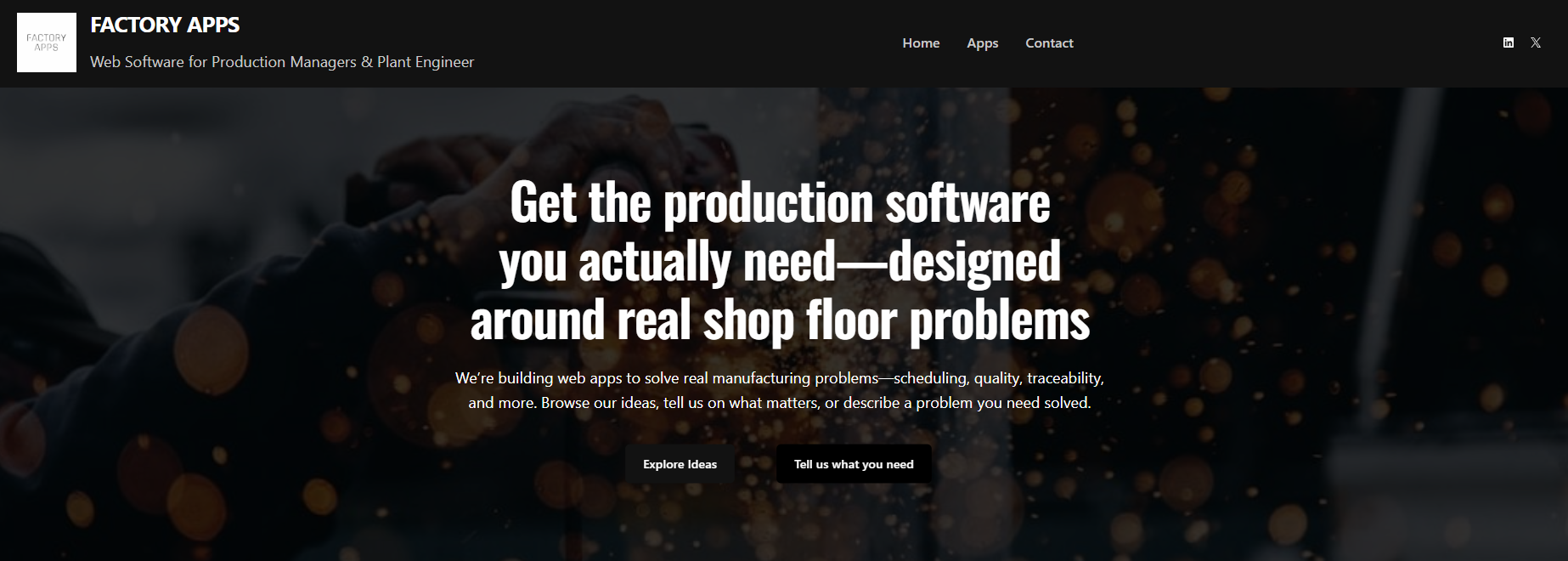
Factory Apps lives at factoryapps.net, where the MVP ideas in progress are listed and interest can be registered through the form on each.
The build journey also runs publicly on LinkedIn and Twitter, with the honest version of it. The wins, the dead ends, and the lessons in between. For anyone running a factory or working in production management who finds any of this familiar, the form on factoryapps.net is the fastest route onto the founder's radar.
Closing Note
Manufacturing has spent years getting its operations to the front edge of what's possible while letting the software underneath drift further and further behind. That mismatch isn't a small inefficiency. It's a quiet tax that compounds across every shift, every breakdown, every misplaced work order. Factory Apps is being built to take that tax off the table, one focused product at a time, for the engineers and managers who've been waiting for tools that finally meet them where they are.