The Hidden Infrastructure Problem in Global Healthcare And What Medverse Is Doing About It
The Hidden Infrastructure Problem in Global Healthcare And What Medverse Is Doing About It
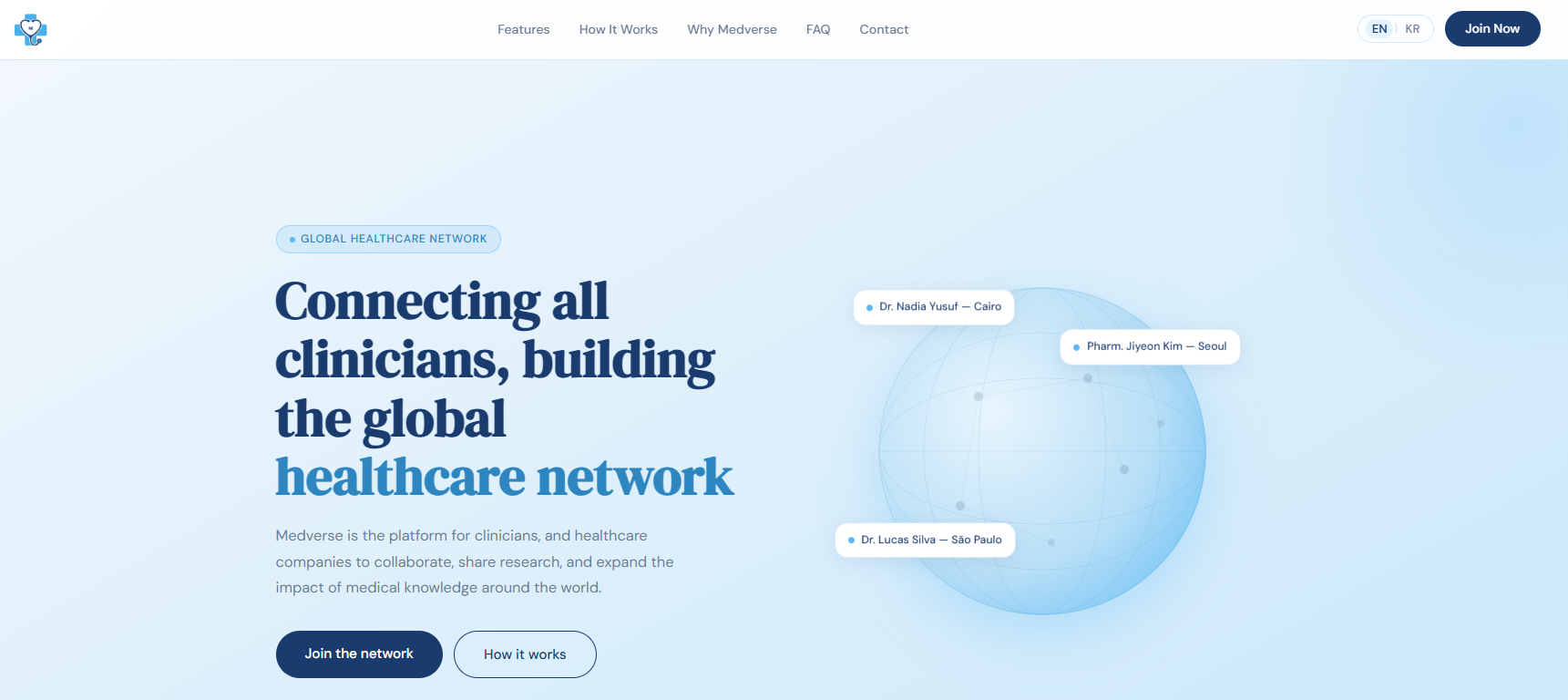
Medverse is building the global operating layer for healthcare professionals, connecting clinicians, hospitals, and organizations across borders, specialties, and languages in one unified platform.
Healthcare doesn't have a knowledge problem. It has a connectivity problem.
Somewhere right now, a nurse in Southeast Asia is qualified for a role that a hospital in Europe is struggling to fill. A pharmacist in one region has no visibility into peer networks two countries over. A specialist sits inside a system that was never designed to surface what's happening outside it.
The industry is global. The tools connecting it are not.
Why Existing Platforms Keep Falling Short
Most professional platforms weren't built for healthcare's specific complexity. They're either too broad, built for general professional networking and stretched to accommodate medical use cases or too narrow, serving one specialty, one region, or one function.
What that leaves is fragmentation.
A clinician looking to grow professionally might be on one platform for job listings, another for peer discussions, and yet another if they want to connect with colleagues abroad. And even then, language barriers and regional gatekeeping quietly limit what's actually accessible.
This isn't a small inconvenience. Fragmented systems slow hiring pipelines, limit professional development, and keep knowledge siloed in ways that have real consequences for the people these professionals serve.
Where Medverse Comes In
Medverse is being built as a unified environment for healthcare professionals, not a social network with medical features bolted on, but a purpose-built platform where connection, hiring, and collaboration all operate in the same place.
The core users it's designed for span the full ecosystem:
Clinicians seeking international career opportunities. Nurses exploring cross-border mobility. Hospitals that need international hiring pipelines with actual reach. Pharmaceutical companies that want direct access to practitioners rather than working through fragmented intermediaries.
Multi-language support is part of the foundation, not an afterthought. So is multi-role architecture, the platform is designed to serve different user types simultaneously rather than forcing one interface to fit all of them.
The Insight That Drove the Build
Medverse didn't start from a market analysis. It started from direct exposure to the gap.
The founders observed firsthand how disconnected healthcare professionals were from each other, not because they lacked interest in connecting, but because no adequate infrastructure existed for it. The tools available were either too generic or too limited in scope.
That direct exposure matters. Platforms built to solve a problem the founders have personally encountered tend to make different product decisions than those built by people observing the problem from a distance.
Utility Over Engagement
One of the clearest signals about where Medverse is heading is how it positions itself functionally.
The platform isn't optimizing for time-on-site or content feeds. It's being built around utility: connections that lead to actual opportunities, hiring flows that cross borders, information sharing that results in action.
This is an important distinction. Many platforms in the professional space generate a lot of passive activity, like scrolling, liking, saving without generating meaningful outcomes. Medverse is built around the premise that a healthcare professional's time is limited and the platform has to earn it by being genuinely useful.
That's a harder product to build. It's also a more defensible one.
Where Things Stand Right Now
Medverse is in active development, operating in the phase where product and adoption grow in parallel. The focus areas at this stage are platform infrastructure, early user engagement, and cross-regional expansion.
This is the phase that determines everything. Early platforms win or lose based on whether the first wave of users finds enough value to stay and bring others in. The fact that Medverse is entering a space with clearly documented pain and no dominant incumbent gives it real runway.
Get in Touch
If you're a healthcare professional, organization, or institution interested in what Medverse is building:
Email: support@medverse.com
Worth Watching
The global healthcare system has needed a proper connectivity layer for a long time. Medverse is one of the few efforts approaching it with the right scope, multi-role, multilingual, cross-border, and built around what professionals actually need to do rather than how much time they spend on the platform.
That's a different bet than most platforms are making. And in an industry this large, getting that right has implications well beyond the platform itself.