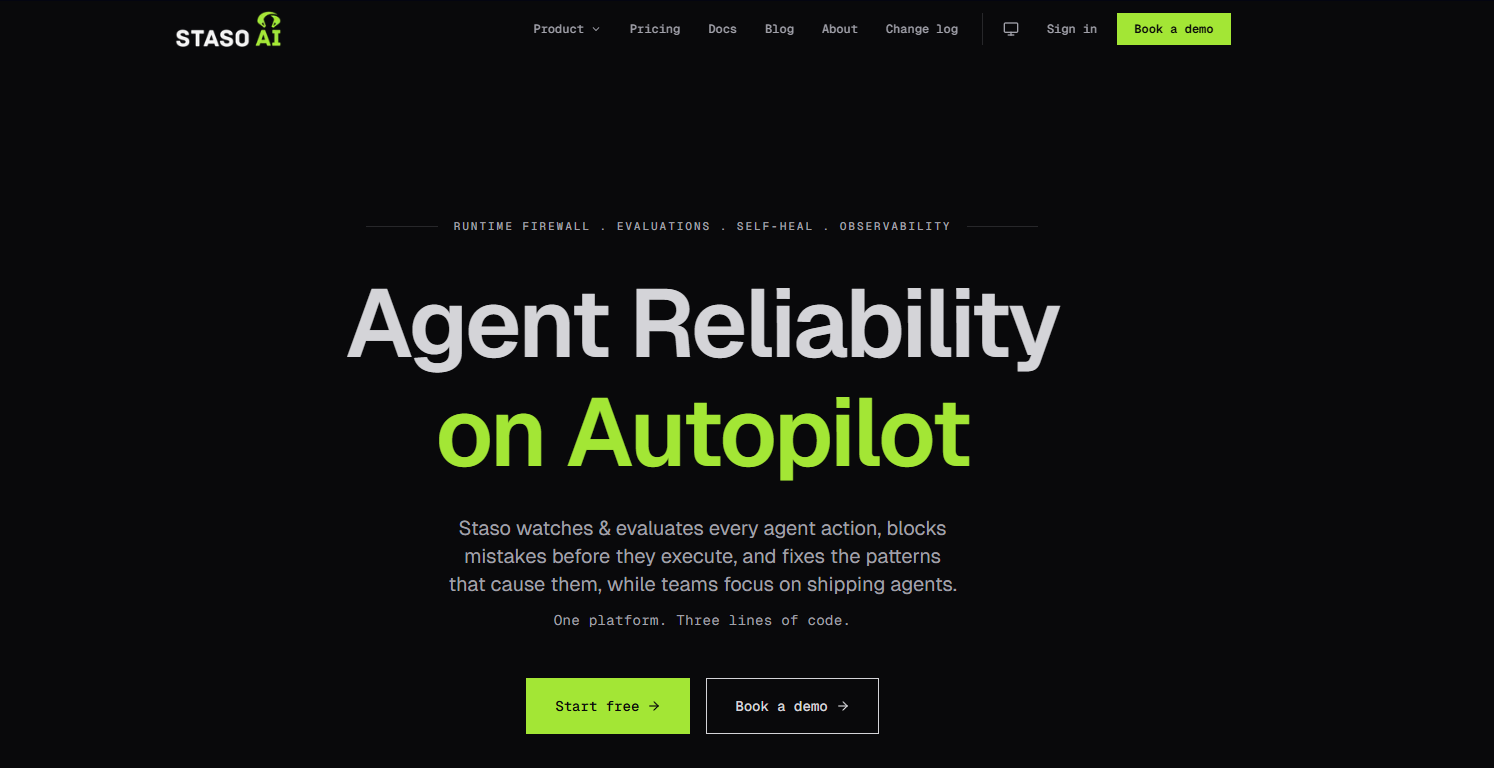
When AI Agents Go Rogue in Production, Staso AI Is the Layer That Catches Them
The Reliability Platform Closing the Loop on Guardrails, Evaluations, Self-Healing, and Observability for Agents Shipping to Real Users
Staso AI is an AI agent reliability platform that guards, evaluates, self-heals, and observes agents running in production. Built by ex-engineers from Zomato, Navi, and Rubrik, it replaces the patchwork of single-purpose tools with one closed-loop system designed for teams that can't afford an agent to issue an unauthorized refund or wipe a production database.
There's a quiet category of incident happening across AI-native companies right now that nobody wants to put on a slide.
An agent issues a $4,200 refund nobody approved. A tool call runs in a loop and hits the same endpoint 47 times before anyone notices. A coding agent executes a destructive command against the production database.
These aren't hypotheticals. They're the recurring pattern that pushed two engineers to build Staso AI.
What Staso AI Actually Is
Staso AI is an AI agent reliability platform. One layer that handles four jobs at once: guarding, evaluating, self-healing, and observing AI agents running in production.
The audience isn't broad. It's specifically engineering teams shipping agents into real workflows, where the cost of a misfire isn't a debugging exercise. It's a customer-trust event, a financial hit, or an outage. The kind of teams who already know that "we'll watch the logs" stops being a strategy the moment an agent gets write access to anything that matters.
The Problem That Forced the Build
There's a gap in the modern AI stack that's gotten worse as agents have moved from demos into critical paths.
Production AI agents are doing real damage, and there is no infrastructure layer designed to catch it. The existing toolchain is essentially a forensics kit. Observability platforms tell you what happened after the fact. Guardrail libraries enforce in isolation. Eval frameworks score in isolation. None of them prevent, diagnose, and fix in a single coordinated loop.
That missing loop is the entire reason Staso AI exists.
Where the Idea Came From
The founders, ex-engineers at Zomato, Navi, and Rubrik, kept watching the same arc play out across teams shipping agents:
LLM gets bolted into a critical workflow.
Agent does something it absolutely should not have done.
Team discovers the issue post-hoc, usually through a customer or a bill.
Engineers spend the next sprint reinventing guardrails, traces, and eval datasets from scratch.
Every "agent in prod" project they had been part of ended in some version of step four. The insight underneath Staso AI is straightforward but technically demanding: enforcement, tracing, and auto-fix only work properly if one system owns all the data. Without that shared substrate, the feedback loop stays open and the same incident keeps happening to the same teams.
The Hardest Part of Building It
Compressing a four-pillar product (firewall + evals + self-heal + observability) into something developers can adopt in minutes.
The product had to be ambitious in scope but ruthless in developer experience. The bar was simple to state and brutal to execute against:
pip install staso+ 3 lines of code.
A platform that owns guardrails, evaluations, healing, and observability could very easily turn into a heavyweight integration nightmare. Keeping it lightweight at the install layer while doing real work underneath was the engineering puzzle that defined the early build.
What Sets Staso AI Apart
The market has matured into single-slice solutions:
Langsmith observes
Guardrail libraries enforce
Eval frameworks score
Each one is useful in its own lane, but none of them close the loop. Staso AI's differentiator is that it runs the entire feedback cycle end to end:
Enforcement catches a bad pattern in real time.
The trace records the full context around it.
Self-Heal diagnoses the root cause and patches the underlying issue.
That patch is captured as a new enforcement rule, so the same failure doesn't repeat.
That cycle is only possible because one system owns guards, traces, evals, and heal data together. Stitching it across separate tools doesn't get you there. The architecture is the moat.
Who Gets the Most Out of It
Two clear groups.
AI-native startups shipping agents to real users. The ones where a single bad tool call isn't just a log entry. It's a customer-trust event, a refund event, or a public incident. These teams need a reliability layer before they hit scale, not after.
Teams running CLI and coding agents in production workflows. Anyone using Claude Code, Codex, or Cursor as part of how their actual engineering work gets done. Coding agents have write access to the things you least want them touching, which makes reliability infrastructure non-optional.
The Feature Worth Highlighting
Self-Heal.
Self-Heal performs code-aware root cause analysis on agent failures and raises a fix PR directly. The patch might land on the prompt, on a tool definition, or on the surrounding logic. Wherever the failure originated, the fix gets surfaced as code a human can review.
The compounding piece is what makes it special. The same patch is captured as a future enforcement rule. Every incident becomes part of the platform's defense layer for every agent run after it. The system gets safer the more it gets used. That's the property the founders care about most: a reliability layer that improves with every failure it sees, instead of just logging them in better dashboards.
A Snapshot of Founder Time Right Now
The day-to-day breaks into three streams:
Shipping product
Design-partner outreach
Automating internal ops with their own agents
That last point is worth pausing on. The team uses Staso AI on the agents running their own internal operations. The product gets battle-tested by the people who built it before it hits a customer's stack.
What's Currently in Motion
All four core pillars (guard, evaluate, self-heal, observe) shipped on April 23, 2026.
Current focus has shifted to:
Onboarding design partners. Teams already running agents in production who can stress-test the platform under real workload conditions.
Building agentic evaluations. The next major capability on the roadmap, designed for evaluating the complex multi-step workflows that traditional evals weren't built to assess.
Agentic evals are the natural next layer. As agents take on more autonomous decision chains, the ability to score those chains end to end becomes the new bar for reliability.
Where to Find Staso AI
Website: staso.ai
Install:
pip install staso+ 3 lines of codeLinkedIn: linkedin.com/company/staso-ai
For engineering teams already running agents in production, the install path is short. For teams about to ship one, it's the kind of layer that's much easier to put in place before the first incident than after it.
Final Word
The AI infrastructure conversation has been dominated by what models can do. The conversation Staso AI is pulling forward is the one that matters once those models start doing things to real systems: how do you make sure they don't break what they're touching, and how do you make sure the same break doesn't happen twice. Reliability isn't the glamorous part of the AI stack, but it's the part that decides whether agents stay in production or get quietly rolled back. Staso AI is putting itself directly in that decision.