Why Most Websites Bleed Revenue Before Visitors Ever Click "Buy"
How Precision Turns Existing Traffic Into Measurable Conversion Gains Through Behavioural Psychology and Structured Experimentation
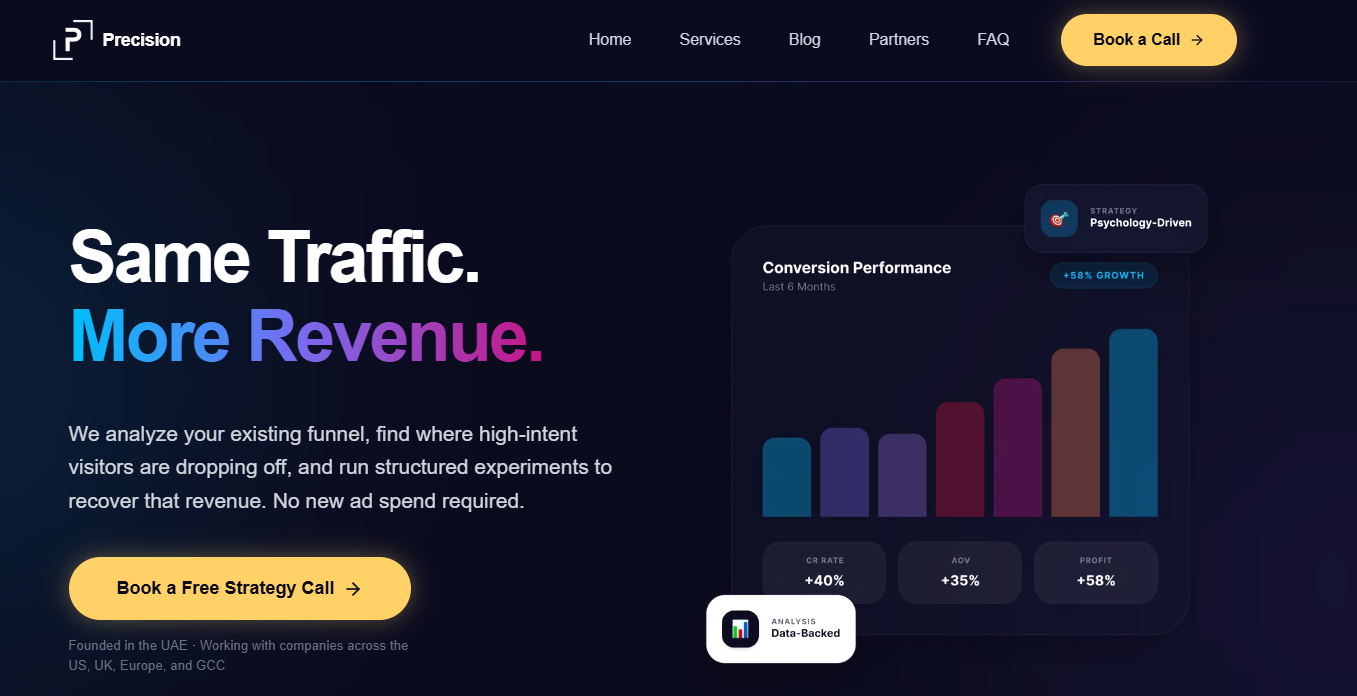
Precision is a CRO and product UX consultancy helping growth-stage businesses convert more of the traffic they already have. Founded by a former Delivery Hero and Alibaba operator, the practice combines commercial discipline with behavioural psychology to fix the leaks that drain revenue from websites and apps.
Most companies have a traffic problem they don't actually have. They keep pouring budget into ads, SEO, and influencer pushes while the real bottleneck sits quietly inside their own funnel. A checkout that asks for too much. A pricing page that buries the answer to the only question that matters. A signup flow that loses people on step three.
That gap, between the visitors a business pays for and the ones who actually convert, is where Precision lives.
The Practice in One Sentence
Precision is a conversion rate optimization (CRO) and product UX consultancy that helps businesses pull more revenue out of the traffic they already have. The work centers on psychology-driven experimentation and structured funnel optimization, and the client roster tends to look the same on paper: growth-stage founders, heads of growth, and product leads who are spending real money on acquisition but watching their return on ad spend underperform.
E-commerce, SaaS, marketplaces, services businesses. The vertical changes. The methodology doesn't. Find the drop-off, understand the behaviour behind it, then fix it through disciplined A/B testing and UX work.
Where the Idea Came From
Before Precision, the founder spent over a decade in commercial and growth leadership at Delivery Hero (Talabat, Foodpanda) and Alibaba Group (Daraz). Different companies, different markets, same recurring pattern: heavy spend on paid traffic, leaky funnels at almost every step, and almost no one assigned to plug the holes.
The fixes were rarely exotic. A clearer landing page. A shorter checkout. A signup that didn't punish the user for showing up. But the cultural gravity inside most growth teams pulls toward "more visitors" rather than "better-performing visitors," so the conversion side gets neglected even when the math screams for attention.
Precision was built to sit specifically in that neglected space.
What Made the Founder Build It This Way
There was also a personal layer to it. After years of running large teams and managing regional P&Ls, the pull toward product and user experience kept getting stronger. The puzzle of why people behave the way they do online, and what you can shift to change both the experience and the conversion rate at once, had been an interest since childhood, rooted in a long-running curiosity about behavioural psychology.
Precision became the place where all of that converged: data analysis, product thinking, and conversion psychology aimed at a problem that directly moves revenue. One non-negotiable was baked in from day one. The work would be built on superior user experiences, not dark patterns.
The Credibility Hurdle
The toughest part of the early days wasn't strategy or methodology. It was perception.
When your résumé reads Delivery Hero and Alibaba, people associate you with those logos rather than with the new thing you're building. Repositioning from "commercial operator at a household-name company" to "founder of a specialist CRO practice" took deliberate work. Publishing CRO content. Mentoring founders on GrowthMentor. Sharing methodology in the open instead of hiding it behind a sales call. Letting client results speak rather than relying on past job titles.
Showing the work, in other words, instead of just referencing the background.
What Actually Separates Precision From a Typical CRO Agency
Two things, both structural rather than cosmetic.
The first is the operator lens. Most CRO agencies are built by agency people. Precision is built by someone who has owned P&Ls, led teams of more than 200, and been on the hook for revenue targets across 15 markets and 8 industries. That changes the filter every recommendation goes through. A test has to make commercial sense, not only statistical sense. Lift on a metric that doesn't translate into real revenue is a vanity result, and Precision treats it as one.
The second is the psychology layer. No random experiments. Every A/B test starts from a specific hypothesis about how people make purchasing decisions, then gets designed around that behaviour. The question is never "what should we try?" It's "what is this user actually thinking at this exact step, and what is getting in their way?"
Who Gets the Most Out of It
Any business with meaningful traffic and a conversion rate that's underperforming its category benchmark. E-commerce brands, SaaS companies, professional services firms, marketplaces. If you've got 10,000+ monthly visitors, an active acquisition budget, and numbers that don't match your investment, the methodology applies.
It works across industries because the psychology of online decision-making is universal. The platforms differ. The friction points differ. The mental shortcuts people use to decide whether to trust, click, or pay don't.
The Deliverable Clients Talk About Most
Every engagement starts with a Deep Dive CRO audit, and it's the piece of work clients reference most often when they describe what they got from Precision.
It's not a checklist. It's a full-funnel analysis from homepage to post-purchase, with every finding prioritised by estimated revenue impact and implementation effort. By the end, the client knows what to fix, what order to fix it in, and why each change matters in behavioural terms. Some clients have implemented only the quick wins and still seen measurable conversion lift within weeks.
That outcome is the point. The audit is meant to be operational, not theoretical.
The Current Rhythm of the Business
Days at Precision split cleanly between client work and building the brand's footprint.
Mornings tend to be deep work: running audits, digging into user behaviour data, designing test hypotheses, or writing about CRO and behavioural psychology. Afternoons shift to client strategy calls and GrowthMentor sessions, where the founder has completed 90+ sessions advising founders on conversion rate optimization, product UX, and growth strategy.
Content investment has stepped up significantly. Precision is building out a CRO resource hub covering pricing psychology, checkout optimization, A/B testing frameworks, and the rest of the discipline.
The Bigger Bet on Content
The hub is being built around a deliberate refusal to gatekeep. Each article is designed to be the definitive resource on its specific topic, grounded in behavioural science, backed by real data, and written from an operator's perspective rather than generic marketing fluff.
The reasoning behind it is simple. The same knowledge that helps a funded startup tighten its checkout helps a solo operator do the same thing on a smaller stack. Founders, solopreneurs, and businesses of every size should have access to the same quality of thinking that enterprise companies pay consultants for. If someone reads a Precision article and fixes their conversion problem without ever booking a call, that's still a win for the practice.
Where to Start
The site is goprecision.co. The blog hosts free guides on conversion rate optimization, A/B testing, product page design, cart optimization, landing page work, and the behavioural science behind purchasing decisions. For specific situations, there's a free strategy call bookable directly from the site.
Closing Thought
The companies that win the next decade of digital growth won't be the ones who simply spent the most on traffic. They'll be the ones who refused to leave revenue sitting on the floor of their own funnels. Precision exists to make that refusal practical, measurable, and grounded in how people actually behave when they're deciding whether to buy.